Call Us : +91-98728-01739 or Email us: sugamhealings@yahoo.com
Why Do I Feel Stuck in Life Even When I’m Trying My Best?
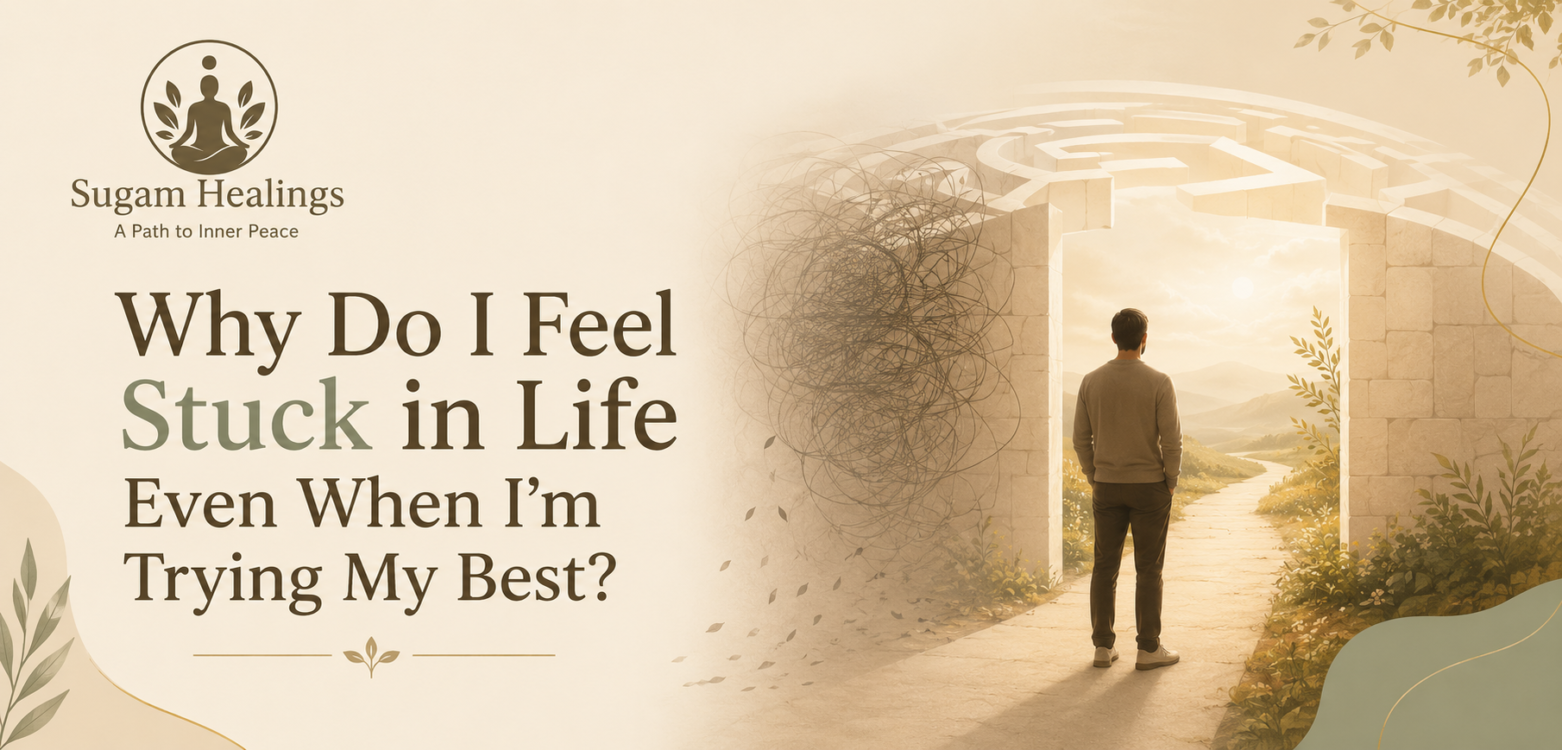
You may be working hard, thinking positively and trying to make better decisions. Yet somewhere inside, you still feel as though your life is not moving forward.
This can lead to a painful question: Why do I feel stuck in life even when I’m trying my best?
Feeling stuck does not necessarily mean that you lack ability, discipline or determination. Sometimes the problem is not a lack of effort. Instead, your energy may be divided between one part of you that wants change and another part that fears what change could bring.
You may also be emotionally tired, unclear about what you truly want or caught in patterns that once helped you feel safe. Therefore, moving forward often requires more than pushing yourself harder.
It begins with understanding what may be holding you back.
Table of Contents
ToggleWhat Does Feeling Stuck in Life Actually Mean?
Feeling stuck in life usually means that you want something to change but cannot find a clear or sustainable way forward.
You may know what you should do, yet struggle to act. Alternatively, you may keep taking action but feel that your efforts are not producing meaningful results.
For some people, feeling stuck appears as procrastination. For others, it shows up as indecision, emotional numbness, exhaustion, confusion or repeatedly returning to the same situation.
You might experience thoughts such as:
- “I am trying, but nothing seems to change.”
- “I know what I need to do, but I cannot make myself do it.”
- “I keep ending up in the same kind of situation.”
- “Everyone else seems to be moving ahead.”
- “Maybe I am simply not capable enough.”
However, these thoughts do not tell the whole story. They describe your frustration, but they may not explain its deeper cause.
Feeling Stuck Does Not Always Mean You Are Not Trying
One common misunderstanding is that people remain stuck because they are lazy or unwilling to take responsibility.
In reality, someone can be making a great deal of effort while using most of their energy simply to manage stress, doubt, emotional pain or daily responsibilities.
For example, imagine a person who wants to change careers. They research courses, update their résumé and regularly think about applying for jobs. However, each time an opportunity appears, they delay submitting the application.
From the outside, this may look like procrastination. Internally, however, the person may be struggling with fear of failure, fear of judgement or a deep belief that they are not capable enough.
Therefore, the visible problem may be inaction, while the deeper pattern may involve fear, emotional exhaustion or low self-trust.
Why Do I Feel Stuck in Life Even When I’m Trying My Best?
There is rarely one single reason. Feeling stuck in life can develop through a combination of emotional, practical, relational and behavioural factors.
You May Be Emotionally Exhausted
When you have been managing stress for a long time, even ordinary decisions can begin to feel difficult.
You may still complete your responsibilities. However, there may be little energy left for planning, creativity, risk-taking or personal change.
Emotional exhaustion can make you believe that you need more motivation. In reality, you may first need rest, support and fewer demands.
Stress can affect emotions, concentration, decision-making, sleep and physical well-being. Small, realistic changes in everyday routines can therefore make a meaningful difference. (CDC)
You May Be Trying to Avoid the Wrong Outcome
Sometimes you are not only moving towards a goal. You are also trying to avoid embarrassment, rejection, loss, conflict or disappointment.
For instance, you may want a healthier relationship but repeatedly avoid expressing your needs. You may want professional growth but hesitate to take opportunities that make you visible.
This does not necessarily mean that you do not want progress. It may mean that your fear of what could go wrong is stronger than your trust in what could go right.
Your Goals May Not Reflect What You Truly Want
A person can work very hard towards a life that does not feel personally meaningful.
Sometimes goals are shaped by family expectations, social comparison or ideas about what success should look like. As a result, you may achieve certain milestones but still feel empty or directionless.
Feeling stuck may therefore be an invitation to ask:
“Am I struggling because this goal is difficult, or because it no longer belongs to me?”
Old Beliefs May Be Limiting New Choices
Repeated experiences can influence what you believe about yourself.
You may carry beliefs such as:
- “I must not make mistakes.”
- “My needs are less important.”
- “It is safer not to take risks.”
- “People like me do not succeed.”
- “I must keep everyone happy.”
- “I have to be completely ready before I begin.”
These beliefs may operate automatically. Therefore, you may not consciously choose them, yet they can still influence your decisions.
Familiar Patterns May Feel Safer Than Unfamiliar Change
People do not always return to familiar situations because those situations are good for them. Sometimes they return because familiarity feels predictable.
A known difficulty can feel emotionally safer than an unknown possibility.
For example, someone may remain in an unfulfilling role because they understand its problems. A new opportunity may offer growth, but it also introduces uncertainty.
Consequently, one part of the person wants freedom while another part prefers the security of what is already known.
You May Be Waiting to Feel Completely Confident
Many people believe confidence must come before action.
However, confidence often develops after a person takes a few manageable steps and discovers that they can cope with the outcome.
Waiting until fear disappears can keep you stuck. A more realistic aim is not to remove every doubt, but to take a sensible step while some uncertainty remains.
Your Next Step May Be Too Large or Unclear
A goal such as “change my life,” “become successful” or “heal completely” is too broad for the mind to act upon easily.
When the next step is unclear, the goal can feel overwhelming.
By contrast, a step such as “spend 20 minutes listing three realistic career options” gives you a specific action.
Structured approaches that connect daily activities with personal values and manageable goals are used within behavioural activation, an established psychological approach. Its components can include activity monitoring, goal clarification, scheduling and reducing avoidance. (ScienceDirect)
Signs That You May Be Experiencing Emotional Stagnation
Emotional stagnation does not appear in exactly the same way for everyone.
You may notice that you:
- Think repeatedly about change but rarely begin
- Start enthusiastically and then withdraw
- Keep asking others what you should do
- Compare your progress with other people
- Feel guilty whenever you rest
- Remain busy without working on what matters most
- Overanalyse small decisions
- Avoid situations where you may be judged
- Repeat similar relationship or workplace patterns
- Feel disconnected from your own needs and preferences
One or two of these experiences may occur during a stressful period. However, when several patterns continue for months and begin affecting your work, relationships, rest or self-worth, deeper reflection may be helpful.
How Feeling Stuck Can Affect Everyday Life
Feeling stuck can gradually influence many areas of life.
Thoughts and Decisions
You may overthink choices because every decision feels important. As a result, you spend more time analysing than acting.
You may also begin doubting decisions immediately after making them.
Emotional Well-Being
Continued frustration can create sadness, irritability, helplessness or self-criticism.
Eventually, you may stop expecting change because repeated effort has not produced the result you wanted.
Work and Productivity
You may remain busy but avoid tasks connected with meaningful progress.
Alternatively, perfectionism may cause you to keep improving plans without completing or sharing your work.
Relationships
When you do not clearly understand or communicate your needs, resentment can build.
You may also repeatedly enter relationships in which you overgive, remain silent or seek approval.
Physical Well-Being
Long periods of stress may affect sleep, energy, appetite and your ability to relax.
Therefore, feeling stuck is not always only a thinking problem. The body may also be carrying strain.
What to Do When You Feel Stuck in Life
Moving forward does not require you to solve your entire life at once.
It requires one clear and manageable next step.
Name the Exact Area Where You Feel Stuck
Instead of saying, “My whole life is stuck,” identify the specific area.
For example:
- “I feel stuck in deciding whether to change my work.”
- “I feel stuck in communicating my needs.”
- “I feel stuck in beginning a project.”
- “I feel stuck in moving beyond a painful relationship.”
A specific problem is easier to understand than a general feeling of failure.
Separate Facts From Fear
Write down what you know and what you fear.
For example:
Fact: I have not applied for a new role yet.
Fear: I will be rejected and feel embarrassed.
This distinction helps you recognise whether you are responding to a current reality or an anticipated outcome.
Ask What the Pattern May Be Protecting You From
Instead of immediately criticising your resistance, become curious about it.
Ask:
- What feels risky about moving forward?
- What might I lose if my life changes?
- Whose approval am I afraid of losing?
- What familiar role would I have to leave behind?
- What would become possible if I trusted myself more?
Resistance may contain useful information. However, understanding it does not mean allowing it to control every decision.
Reduce the Size of the Next Step
Choose a step that feels small enough to begin.
Rather than “find a new career,” you might:
- Write down your transferable skills.
- Speak with one person working in an interesting field.
- Research one relevant course.
- Update one section of your résumé.
- Submit one carefully chosen application.
Small actions create information. Information then helps you decide the next step.
Create Evidence of Movement
At the end of each day, record one action that supported your progress.
It could be making a phone call, setting a boundary, completing a task or allowing yourself to rest without guilt.
This practice shifts your attention from everything that remains unfinished to the movement that is already happening.
Check Your Physical and Emotional Capacity
Before demanding more discipline, consider your current capacity.
Ask whether you are sleeping adequately, managing excessive responsibilities or carrying ongoing emotional stress.
Sometimes the next healthy step is not doing more. It is creating enough stability to act with greater clarity.
How Personalised Therapeutic Support May Help
Self-reflection may be enough when the stuck feeling is temporary and connected with a specific decision.
However, personalised support may be useful when the same pattern repeatedly affects your confidence, relationships, emotional balance or ability to act.
Trauma-Informed Support
Trauma-informed support does not assume that every difficulty comes from trauma.
Instead, it creates a safe and respectful space to understand emotional reactions without judgement. It may help a person recognise what triggers withdrawal, fear, overthinking or emotional shutdown.
Inner Child Work
Inner child work may help a person explore emotional beliefs and coping patterns that developed during earlier experiences.
For example, an adult who avoids disagreement may discover that expressing needs once felt unsafe. Understanding this connection can support more conscious responses in the present.
Sugam Healings describes inner child work as an approach that may include guided reflection, hypnotherapy and awareness of emotional and bodily responses. (www.sugamhealings.com)
Hypnotherapy and Subconscious Exploration
Hypnotherapy may provide a structured way to explore automatic beliefs, emotional associations and repeated responses.
It is not about losing control. Instead, it may support focused attention and deeper awareness of patterns that are difficult to understand through ordinary thinking alone.
At Sugam Healings, hypnotherapy is presented within a trauma-informed and consciousness-based framework rather than as a guaranteed cure. (www.sugamhealings.com)
Mindfulness and Emotional Awareness
Mindfulness helps you notice thoughts, emotions and body responses without immediately reacting to them.
This pause can help you distinguish between what is happening now and what your fear expects to happen.
Over time, greater awareness may make it easier to choose a response rather than automatically repeating an old one.
Understanding the Pattern Can Help You Change the Response
When you are feeling stuck in life, pushing yourself harder is not always the answer.
First, you may need to understand whether you are dealing with exhaustion, fear, unclear goals, perfectionism, an old emotional belief or a practical obstacle.
Self-reflection may be enough when the pattern is mild and temporary. However, personalised support may be appropriate when the same difficulty keeps returning or significantly disrupts your daily life.
Sugam Healings may support this exploration through trauma-informed reflection, inner child work, hypnotherapy, mindfulness and subconscious awareness. The purpose is not to force change, but to understand what is preventing change from feeling possible.
You are not required to know every answer before taking the next step. Sometimes progress begins when you replace the question, “What is wrong with me?” with a more useful one:
“What is this pattern trying to tell me?”
Frequently Asked Questions
Why do I feel stuck in life even when I’m trying my best?
You may feel stuck because effort alone does not always address the real obstacle. Emotional exhaustion, fear, perfectionism, unclear goals, old beliefs or difficult circumstances can all interfere with progress. Identifying the specific area and pattern is often more helpful than simply increasing pressure on yourself.
Is feeling stuck in life a sign of depression?
Not necessarily. People can feel stuck during stress, grief, uncertainty, burnout or major life changes. However, persistent loss of interest, hopelessness, major changes in sleep or appetite, or difficulty managing everyday responsibilities may justify speaking with a qualified mental-health professional. NIMH recommends considering the severity, duration and effect of symptoms on daily functioning when deciding whether support is needed. (National Institute of Mental Health)
Why do I know what to do but still cannot do it?
Knowing what to do is an intellectual process, while taking action may involve emotions, habits, confidence and perceived safety. Fear of failure, perfectionism or overwhelm may block action even when the next step appears logically clear. Reducing the size of the task and exploring the fear behind avoidance may help.
How do I stop feeling stuck in life?
Begin by identifying one specific area where you feel stuck. Then separate facts from fears, choose one manageable action and observe what emotional resistance appears. Consistent small actions usually provide more clarity than waiting for complete confidence or motivation.
Can therapy help when I feel stuck?
Therapy may help when the stuck feeling is persistent, repeated or connected with emotional distress. A therapist can help you explore beliefs, fears, relationship patterns, unresolved experiences and practical barriers. The approach should be personalised rather than assuming that one explanation or method applies to everyone.
How long does it take to move past emotional stagnation?
There is no fixed timeline. It depends on the cause, duration of the pattern, current circumstances, available support and the changes you are trying to make. Some people gain clarity quickly, while deeper recurring patterns may require gradual exploration and practice.